
AI Data Centers Are Moving Into Houses: What It Means for Metro Atlanta Homeowners
What it means for buyers, sellers, and homeowners across Alpharetta, Roswell, Buckhead, and Sandy Springs
For the last two years, the AI data center story has mostly played out far from the neighborhoods most of my clients live in. These include rural land deals in Newton County, massive server farms swallowing pastureland outside the Perimeter, headlines about “hyperscale” campuses the size of small airports. It felt like something happening near Atlanta, not in it.
That's changing fast, and it's changing in two different ways at once. One is literal: AI compute is now being engineered to live inside actual houses. The other is economic: the data center boom is already showing up in your power bill, your neighbor's land offer, and possibly your next appraisal, whether a server rack ever gets built near you or not. If you own a home in metro Atlanta, or you're thinking about buying or selling one in the next year, both trends are worth understanding.
What "AI Data Centers in Houses" Actually Means Right Now
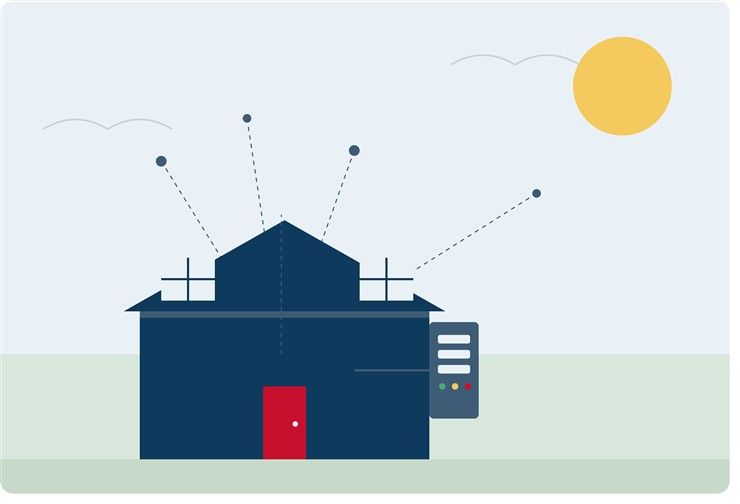
This isn't a metaphor. Nvidia has partnered with electrical panel startup Span and national homebuilder PulteGroup to install small AI compute units, called XFRA nodes, directly into newly built homes. These units function like miniature data centers attached to a house, drawing on unused capacity in Span's smart electrical panels to process AI workloads. PulteGroup operates more than 1,000 active communities across 45-plus U.S. markets, which gives this concept an unusually fast path into real neighborhoods rather than staying a lab experiment.
The idea builds on something homeowners are already somewhat familiar with: using spare home capacity for crypto mining or selling excess rooftop solar back to the grid. The difference is scale and intent. Instead of one homeowner's side project, this is a coordinated network where inference-level AI workloads (the “running” of AI models, as opposed to the much more power-hungry work of training them) get spread across thousands of individual homes, each acting as a small node in a distributed system.
It's early. Feasibility depends heavily on available power, internet speed, and heat management, and the model works better for batch processing than for real-time, high-density AI training. But the fact that the largest GPU maker in the world and a top-five national homebuilder are testing this on production homes tells you it's more than a thought experiment. If it scales, "AI-ready wiring" could become a listing feature the way solar panels or EV chargers are today. Buyers will start asking realtors about it the way they now ask about internet providers.
The Bigger Force Already Reshaping Metro Atlanta Real Estate
While in-home AI nodes are still new, the broader data center economy is already affecting Georgia real estate in ways that matter more immediately to most of my clients.
Nationally, data center developers are outbidding homebuilders for land, sometimes dramatically. In parts of Northern Virginia, land that historically traded for roughly $90,000–$125,000 per acre has seen data center offers north of $4 million per acre for assemblage sites. Illinois developers have purchased and razed entire blocks of homes to make room for server campuses. Texas land along a major corridor jumped from the $20,000–$40,000 per acre range to more than $350,000 per acre in just a few years. Georgia isn't immune to this dynamic, and it's part of why land near existing power infrastructure across the metro is drawing unusual interest from investors who aren't buying it to build houses.
Then there's the grid itself. Georgia Power has been approved to add roughly 10,000 megawatts of new generation capacity, enough to power about 4 million Georgia homes, with the large majority of that new capacity earmarked for data centers. The project carries an estimated $50–60 billion price tag over its lifetime. Georgia Power and the Public Service Commission maintain that data center customers will cover their fair share of those costs and that revenue from large users will eventually put “downward pressure” on residential rates after the current base rate freeze ends in 2028. Commissioners have also opened a fresh review this July into exactly how data centers are being charged, and the state's Environmental Protection Division has sent violation notices tied to a data center project in Newton County, a sign that oversight in this space is still actively being worked out, not settled.
What This Means for Your Electric Bill and Your Home's Value
Here's the part that shows up in mailboxes before it shows up in listings: Georgia Power has raised residential rates multiple times over the past three years, and advocacy groups tracking the trend say the average monthly bill has climbed from roughly $150 to around $225 for many customers. Utility and regulators dispute how much of that increase is attributable to data centers versus other factors, and that debate is genuinely unresolved. What's not in dispute is that data centers are now a major, permanent part of how Georgia's grid gets planned and priced, and homeowners are watching their utility costs more closely as a result.
On the flip side, there's an emerging argument on the real estate side that proximity to upgraded grid infrastructure isn't purely a negative. Areas near substation and fiber upgrades tied to data center buildouts sometimes see modest home value premiums tied to improved grid resilience, and the high-wage jobs that come with major tech campuses can support housing demand in surrounding submarkets. National surveys, including one commissioned by Redfin, found that close to half of Americans oppose having a data center built directly in their neighborhood so the value story cuts both ways depending on distance, noise, and how a given project is received locally.
Buckhead, Sandy Springs, Alpharetta, and Roswell: What Local Buyers and Sellers Should Watch
None of my core markets are current sites for a hyperscale data center campus, and that's not likely to change given how built-out and residential these submarkets already are. But the ripple effects are worth watching for a few reasons:
Utility costs are now a bigger line item in affordability conversations. When I talk with buyers about monthly carrying costs, I'm factoring in Georgia Power's trajectory alongside insurance and taxes more than I would have two years ago.
New construction may start marketing "AI-ready" electrical infrastructure. If PulteGroup or other builders expand the XFRA concept, expect it to show up as a feature in new-build communities, the same way solar-readiness and EV charging did.
Land near transmission and substation upgrades is drawing outside investor interest. If you own acreage or a property near planned infrastructure work, it's worth understanding whether that interest is coming from developers, not just other homeowners, before you price a sale.
Regulatory outcomes are still moving. The Georgia PSC's active review of data center rate methodology could shift residential bills in either direction over the next 12–18 months, and it's a story worth tracking if you're planning a long-term hold or a near-term sale.
Questions to Ask Before You Buy or List in the AI Infrastructure Era
- Is this neighborhood, or one nearby, near any planned substation, transmission, or fiber upgrade tied to data center development?
- For new construction: does the builder offer or plan to offer distributed AI compute or "smart panel" infrastructure, and does it come with any compensation, cost, or maintenance obligation?
- Has this property's utility usage or rate class changed in the last two years in a way that affects monthly costs?
- If I'm selling land or an underused parcel, has anyone approached me with a purchase offer meaningfully above comparable sales? That can be a signal worth investigating rather than dismissing.
The Bottom Line
AI data centers moving into houses sounds like a headline from a few years down the road, but pieces of it are already live in production homes today, and the economic version of the story. This includes grid buildouts, rate cases, land competition which is already shaping costs and decisions across metro Atlanta right now. You don't need to become an energy policy expert to buy or sell well in this market. You just need someone tracking it alongside the fundamentals that have always mattered: location, condition, financing, and timing.
If you're weighing a move in Alpharetta, Roswell, Buckhead, or Sandy Springs and want to talk through how any of this factors into your specific situation, reach out and I'm happy to walk through it with you.
Categories
Recent Posts




"Whether buying or selling a home, my #1 job is to advise my clients so they optimize their largest financial investment while avoiding any pitfalls that could cost them tens of thousands of dollars. "