
The Hidden Cost of Homeownership: Mapping the U.S. Property Tax Landscape
When we talk about the "cost" of a home, we usually start and end with the purchase price and the mortgage rate. But for long-term homeowners and investors, there is a recurring line item that can make or break a monthly budget: Property Taxes.
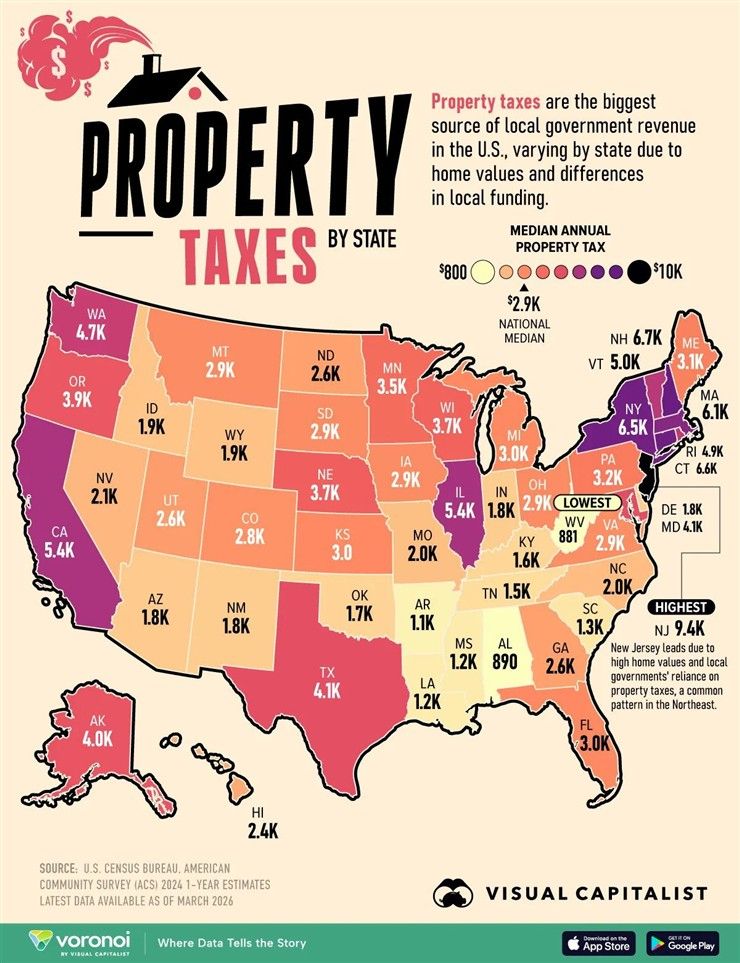
A recent report from Realtor.com (visualized in the map below) highlights just how much these costs vary depending on where you plant your roots. From the sub-$1,000 bills in the Deep South to the $9,000+ burdens in the Northeast, the "tax gap" in America has never been more apparent.
The National Picture
Across the United States, the average property tax bill has continued to climb, driven by rising home valuations. However, the map reveals a stark divide.
States like New Jersey ($9,413) and Connecticut ($6,944) lead the nation in tax burden, often as a trade-off for localized funding of top-tier public school systems and infrastructure. On the flip side, states like Alabama ($804) and West Virginia ($728) offer the lowest entry points for homeowners, though these figures often correlate with different levels of public services.
A Closer Look at Georgia: The "Sweet Spot"
For those of us looking at the Southeast market, Georgia continues to present a compelling case for affordability.
The national median property tax bill currently sits at approximately $2,931. Interestingly, Georgia’s property tax burden of $2,683 falls comfortably below that national median. For homeowners, this represents a "Goldilocks" scenario:
-
Competitive Carrying Costs: Lower taxes mean more of your monthly payment goes toward principal or savings rather than the local treasury.
-
Value Retention: Georgia manages to keep taxes lower than the national average while still maintaining the growth and infrastructure that drive long-term property appreciation.
Why Carrying Costs Matter in 2024 and Beyond
As we navigate a market of fluctuating interest rates, "carrying costs"—the combined total of your taxes, insurance, and maintenance—have become the most important metrics in real estate.
When property taxes are lower, your "purchasing power" increases. A buyer in Georgia can often afford a significantly higher-priced home than a buyer in Illinois or New York, simply because they aren't losing $500–$800 a month to the tax assessor.
The Bottom Line
Before you buy your next home or investment property, look past the listing price. Research the millage rates and the history of assessments in your specific county. As the map shows, where you buy is just as important as what you buy when it comes to your bottom line.
What do you think of these numbers? Does Georgia’s sub-median tax rate make it more attractive for your next move? Let’s discuss in the comments.
Categories
Recent Posts





"Whether buying or selling a home, my #1 job is to advise my clients so they optimize their largest financial investment while avoiding any pitfalls that could cost them tens of thousands of dollars. "